


Asymmetry and Off-Centre Placement in Lighting Design
A pendant or chandelier does not need to hang from the centre of a room. In practice, it often hangs wherever the electrical point happens to be – and that is not necessarily the same place.
Rooms are often wired before their furniture is chosen, so a pendant ends up governed by where a builder once ran a wire, not by where the room actually asks to be lit.
Once placement is freed from the electrical point, asymmetry becomes a genuine design decision rather than a compromise.
Position, not proportion
The Spider system, designed by Andrea Tosetto for Lodes, puts that principle into practice. Each of its pendants swivels 360 degrees horizontally and tilts 90 degrees vertically from a single canopy, so a fourteen-light configuration can be spread across an irregular ceiling as the room requires, rather than clustered obediently beneath a central rose. The seven-light version applies the same logic at domestic scale.
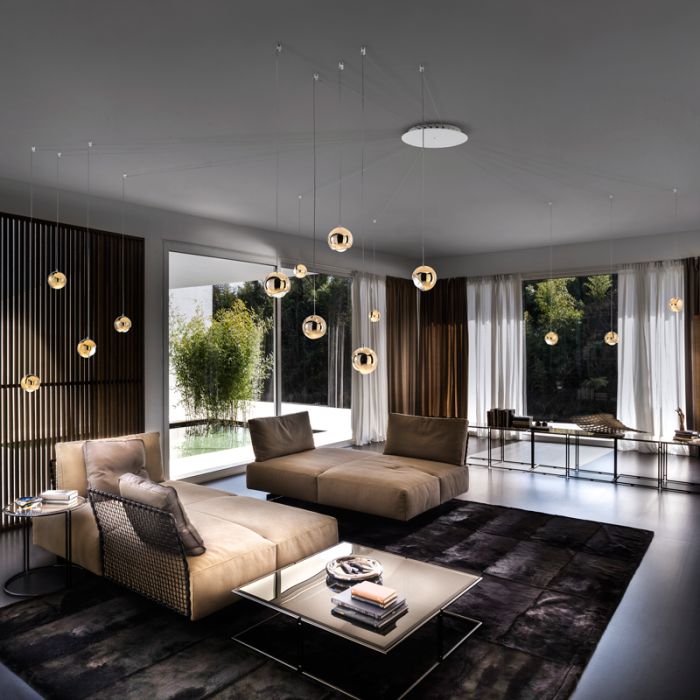

What both compositions share is a shift in the designer's question. Instead of asking where the ceiling permits a light to hang, they ask where the room needs one.
Making asymmetry deliberate
Modularity makes that decision visible. Two customisable cluster pendants demonstrate the same principle through different variables. The first, built from metal, smoked glass and cylindrical diffusers, can be configured in a range of pendant compositions. The second, combining illuminated and decorative elements, allows different composition sizes and finishes. Both allow the composition to be configured rather than imposed, so a room can be lit with pieces of varying length, suspended to different heights and mixed from a small palette of finishes. The arrangement can be designed through a set of deliberate variables – length, spacing and finish.
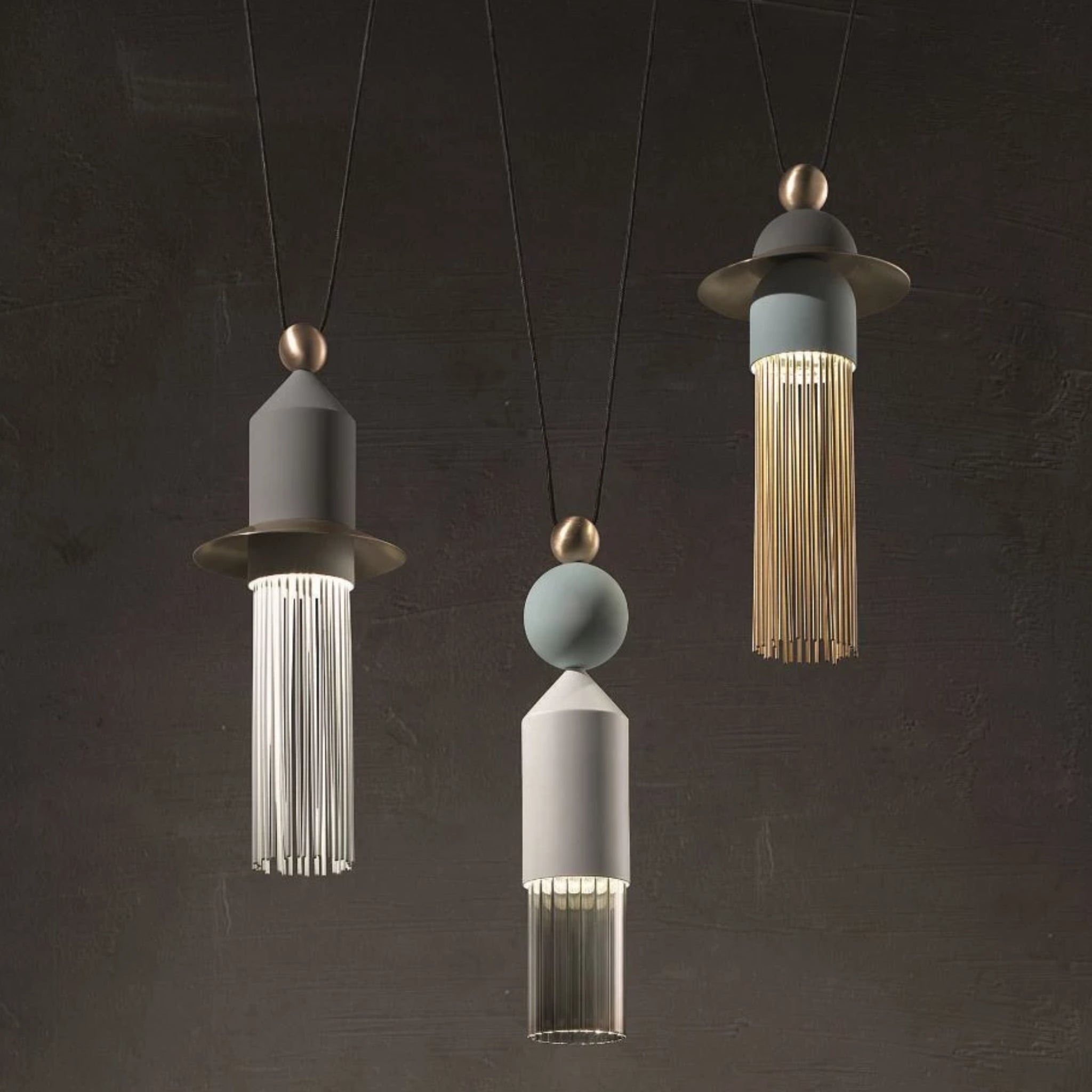

An off-centre pendant reads as a mistake unless something about its placement signals intent – repetition of a finish, a consistent logic to the spacing, a visible relationship between the pieces. Randomness and asymmetry are not the same thing, and a good composition depends on the difference.
When asymmetry becomes more than position
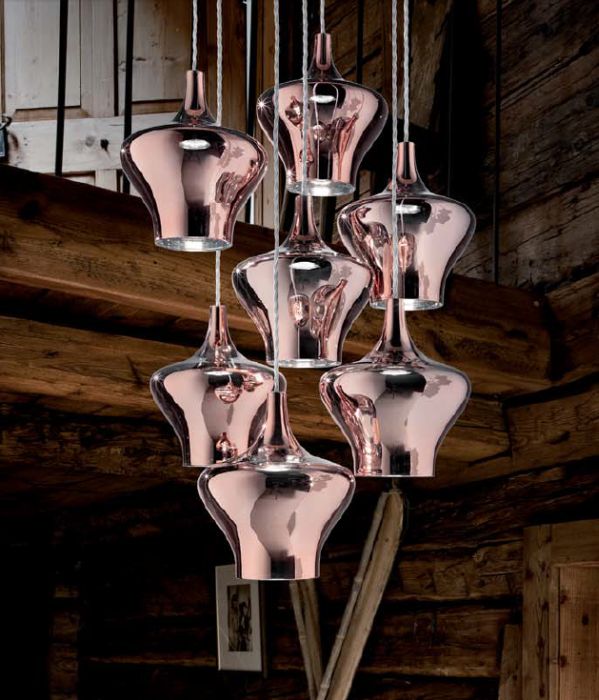
Lodes' Nostalgia system, created by Dima Loginoff, adds another layer to the same argument. Its borosilicate glass diffusers come in three shapes, which can be combined, coloured and hung at different heights within a single custom composition. Where the Spider system solves asymmetry through position alone, Nostalgia introduces another dimension through the interplay of form, colour and height, with different combinations suited to different architectural conditions. A low-ceilinged dining space may call for restraint in height and form, while a taller stairwell gives variation in form and suspension more room to register.
Scale as the final register
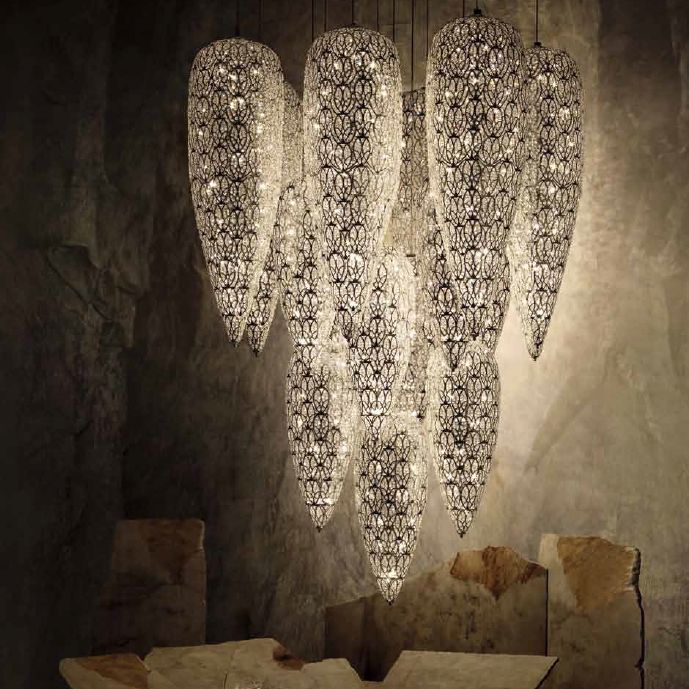
At the largest scale, this approach becomes architectural in itself. The 390cm Large Composition Droplet Chandelier's pendants spread wide enough to answer to a room's full proportions rather than a single table or seating area. The Customizable Modern Statement Chandelier makes the same point at a comparable scale, spanning 200 by 180cm. Both pieces extend the principle established by the smaller compositions, simply at a scale where the relationship between fitting and architecture becomes part of the design itself: once a fitting is large enough, the question of where it belongs stops being incidental and becomes the whole design brief.

In short
None of this asks a room to abandon symmetry altogether. It asks that placement be treated as a decision, not an inheritance. The cable determines where a light can be installed; it doesn't determine where it should be. Once that distinction is made deliberately, asymmetry stops being an exception to good design and becomes an ordinary part of it.
© 2026 Italian Lighting Centre. All rights reserved.
